UNGA79 Sixth Committee Report of the International Law Commission
Cluster II – Chapters: IV (Settlement of disputes to which international organizations are parties) and V (Subsidiary means for the determination of rules of international law)
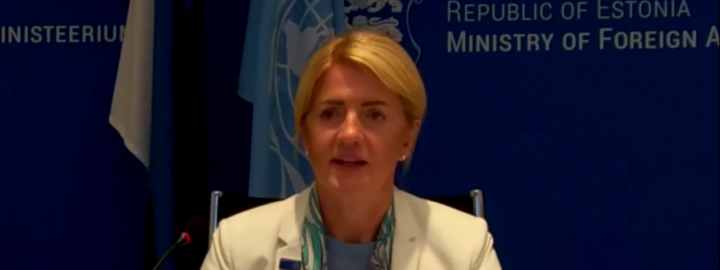
Statement delivered by Ms. Kaisa Männik, Legal Adviser at the Permanent Mission of Estonia
29 October 2024, New York
Chairperson,
Estonia aligns itself with the statement by the European Union, and adds the following comments in its national capacity.
I would like to start with addressing the topic of settlement of disputes to which international organizations are parties. To begin with, I want to express gratitude to the Special Rapporteur Mr August Reinisch for his report and to the ILC members for their contributions to discussions on the topic.
Estonia welcomes the deliberations on the important topic of settlement of disputes to which international organizations are parties. Everyone deserves access to justice regardless of whether the insured party or the responsible party is a state or an international organization.
We echo that the principle of good faith and spirit of cooperation must be applied as widely as possible in order to find amicable solutions for the disputes to which international organizations are parties. We should not set limits to means that could be used for peaceful settlement. Therefore, we feel that the phrase “referred to in draft guideline 2, subparagraph (c)” in Guideline 4 could be deleted.
We hope that the ILC continues to develop the guidelines in a way that they codify the existing practices concerning the settlement of disputes to which international organizations are parties. Also, we believe it is crucial to uphold the rule of law principle that includes aspects of due process.
When it comes to the future discussions related the privileges and immunities of international organizations, we do not see major issues regarding the existing framework on privileges and immunities. The ILC could focus more on certain timely and challenging issues. For example, we wonder if bundled claims that may happen before international organisations could be addressed in the work of ILC.
Allow me to explain. The bundled claims in question means a claim that is directed at several states and contain different complainants. In other words, not all States are accused of the same breach. Such bundling of claims leads to the breach of the principle of due process as presented facts, supporting data and the statement of law is not relevant for all respondent States. Eventually, this leads to the fact that States are not adequately informed of the procedure and are not able to prepare for effective defence. The international organization that is a forum for peaceful settlement of disputes or brings claims against the respondent States has to make sure that each respondent State is treated individually.
Estonia hopes that the ILC can consider bundled claims in their discussions and provide guidance in order to help to avoid unnecessary misunderstandings as well as unnecessary disputes against international organizations. It would provide legal clarity with the aim to avoid procedural deficiencies that may lead to full or partial inadmissibility of a claim.
Mr/Mrs Chairperson,
Now, let me turn to the topic of subsidiary means for the determination of rules of international law.
Estonia would like to thank Special Rapporteur Mr. Charles Chernor Jalloh for his report on this important topic. We are also grateful to the Secretariat for their memorandum identifying the elements in the case law of international courts and tribunals and other bodies, which would be particularly relevant for the ILC’s work on the topic.
We appreciate the progress the ILC has made on the topic since the last sessions and the provisional adoption of draft Conclusions 4 to 8 and the commentaries thereto.
With regard to draft conclusion 4, we concur with the ILC’s approach that the role of the decisions of national courts and tribunals, as subsidiary means for determining the existence and/or content of the rules of international law, is more limited. Paragraph 2 of Conclusion 4 contains the phrases “may be used” and “in certain circumstances” that reflect well this more limited role and the cautious approach that the ILC wishes States to take. Also, the phrase “in certain circumstances” immediately begs the question – what are these circumstances? The commentaries shed some light on this issue. However, we would like to see further clarifications on the hierarchy of national courts and tribunals, and the weight that should accordingly be given to the decisions of national courts or tribunals at a specific level of hierarchy. This matter could be elaborated in the commentary to draft Conclusion 4 or 8.
Concerning draft Conclusion 6, Estonia appreciates the expressis verbis negative statement in paragraph 1 that subsidiary means are not a source of international law, and that they only have an assistive role in determining the existence or content of a rule of international law. This makes it very clear that one must first turn to main sources of international law. But we can turn to subsidiary means, if it is necessary to provide further support to existing international rules or to clarify their content.
Similarly, we agree to the sentence in the draft Conclusion 7, according to which the decisions of international courts and tribunals do not constitute legally binding precedent, unless otherwise provided for in a specific instrument or a rule of international law. Estonia believes that it is important to provide clarity on this matter, especially given the differences of understanding in the common law and civil law legal systems. Legal certainty and predictability are fundamental to the rule of law. Therefore, it is understandable that the previous decisions of international courts and tribunals may be followed on points of law when addressing similar issues. At the international level, this helps to protect the rules-based world order. Estonia finds that the wording of draft Conclusion 7 chosen by the ILC is clearer than the one proposed in the report by the Special Rapporteur. We appreciate the thorough explanations in the commentary to the draft Conclusion 7 regarding the absence of a legally binding precedent in international law.
Chairperson,
In conclusion, Estonia would once again like to express its gratitude to the ILC, and Special Rapporteurs for their outstanding work on both topics. We are looking forward to the continuation of work and debates on both topics in the future.
Thank you for your attention.