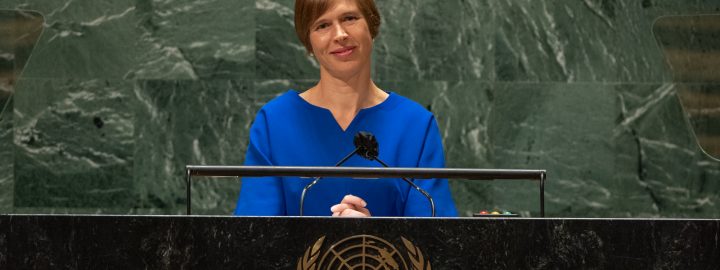
UNGA81 First Committee General Debate
Statement delivered by H.E. Mr. Rein Tammsaar, Permanent Representative of Estonia
7 October 2026, New York
Thank you, Chair,
Allow me to congratulate you on assuming the Chairmanship of the 81st Session of the First Committee. I assure you of my delegation’s full support. Estonia aligns itself with the statement of the European Union. I would also like to make a number of remarks in my national capacity.
Chair,
The First Committee is meeting against a backdrop of heightened international tensions and serious proliferation challenges. Russia’s war of aggression against Ukraine remains the most serious threat to international peace and security. Russia´s aggression has caused enormous human suffering, devastated civilian infrastructure, and created severe humanitarian consequences. Russia’s conduct is fundamentally at odds not only with the responsibilities and obligations of a Permanent Member of the Security Council, but also with the principles expected of every UN Member State.
Russia has also violated international law by seizing, militarizing and controlling Ukraine´s Zaporizhzhia Nuclear Power Plant. Any damage to the plant or disruption of its operations could have catastrophic and far-reaching consequences. Any attempt to connect and integrate the plant into the Russian power grid would create additional serious risks. Such actions could endanger countless lives, contaminate vast areas with radiation, and cause long-term environmental, economic, and humanitarian devastation well beyond Ukraine’s borders.
The path forward requires stronger and sustained collective international pressure on Russia to bring an end to the war and secure a just and lasting peace in Ukraine. Russia must be held to the full obligations of a Permanent Member of the Security Council and comply with the principles and responsibilities enshrined in the UN Charter.
Estonia also strongly condemns the continued military support provided by the DPRK, Belarus, and Iran to Russia, which enables it to sustain its war of aggression against Ukraine. We also call on China to end its role as a decisive enabler of this war. By ending its material and political support for Russia’s war effort and acting in full accordance with the UN Charter and international law, China can demonstrate the responsibility expected of a permanent member of the Security Council.
Chair,
The Treaty on the Non-Proliferation of Nuclear Weapons remains the cornerstone of the global nuclear non-proliferation regime and a fundamental framework for nuclear disarmament and the peaceful uses of nuclear energy. The failure of the 11th Review Conference to reach consensus on a substantive final document is regrettable. It makes our collective commitment to the Treaty all the more important. We call on all NPT States Parties to uphold, implement and further strengthen the Treaty, and to advance its universalization.
NATO’s nuclear deterrence posture, including its nuclear sharing arrangements, is fully consistent with the NPT and remains a cornerstone of Euro-Atlantic security. NATO’s extended deterrence has long contributed to preventing proliferation and creating a more stable security environment. In an increasingly insecure world, it remains critical to deterring aggression, promoting peace and collective security, and preventing conflict. Estonia also welcomes the French initiative to strengthen deterrence on the European continent.
Estonia supports all international efforts towards the entry into force of the Comprehensive Nuclear-Test-Ban Treaty. We urge all States, in particular the remaining Annex 2 States, to take the steps necessary for the Treaty’s entry into force. Estonia also supports the immediate commencement of negotiations on a Fissile Material Cut-Off Treaty and calls on nuclear-weapon States to declare or maintain moratoria on the production of fissile material for nuclear weapons and other nuclear explosive devices.
Chair,
We cannot discuss nuclear non-proliferation without addressing Russia´s reckless and escalatory nuclear rhetoric, threats and signaling. Russia´s announced deployment of nuclear weapons in Belarus, its revocation of its ratification of the CTBT, its violation of the Budapest Memorandum, and its suspension of participation in New START, have all contributed to the erosion of nuclear restraint and strategic stability. New START expired on 5 February 2026, leaving the world without binding limits on the strategic nuclear arsenals of Russia and the United States.
Estonia is deeply concerned by China’s rapid and opaque expansion of its nuclear arsenal. China’s growing nuclear capabilities risk adding further complexity to the strategic environment and make greater transparency and dialogue increasingly important. These measures are essential to reducing mistrust and strategic uncertainty. We therefore call on China to engage constructively in nuclear risk reduction and arms control, including through greater transparency, reliable communication channels, and clarification of its strategic intentions.
The situation in the Gulf region raises serious concerns for regional and global security. Estonia condemns Iran´s attacks against regional states and vessels in the strongest terms and supports diplomatic efforts aimed at a lasting solution in accordance with international law. We remain deeply concerned about the challenges surrounding Iran’s nuclear program and its cooperation with the International Atomic Energy Agency. Iran must fully cooperate with the IAEA, ensure transparency, and comply with its international obligations. In particular, Iran must comply fully with its safeguards obligations and provide the IAEA with the information and access it requires for verification.
Estonia strongly condemns the DPRK’s continued development of its nuclear weapons and ballistic missile programs. These programs threaten regional and international peace and security. The DPRK’s military cooperation with Russia, including the transfer of ballistic missiles, further undermines international security and violates relevant UN Security Council resolutions. We call on the DPRK to abandon its nuclear weapons and ballistic missile programs, comply with relevant Security Council resolutions, and cooperate fully with the IAEA.
Chair,
Estonia remains firmly committed to strengthening international law and effective multilateralism, with the UN at its core. We will continue to support the implementation and strengthening of existing disarmament, arms control, and non-proliferation instruments.
Thank you, Chair.