
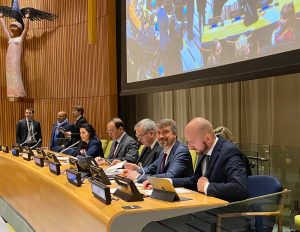
Deputy Permanent Representative Gert Auväärt
UNGA 74
Arria Formula meeting,
Statement on Protection of Environment during Armed Conflict,
December 9, New York
Thank you, Mr Chair!
I would like to begin by thanking Kuwait, Peru and Germany, the the co-hosts of the meeting for their opening remarks. We would also like to express gratitude to the briefers for their insightful views on this important issue.
We have heard about the environmental damages in Kuwait in the result of the armed conflict, the example that needs to be learned from. Estonia fully emphasizes the need to raise greater international awareness of implications of war on environment and pollution resulting from armed conflict or terrorism.
Making progress on the environmental issues in the security context is one of our priorities during our term on the Security Council. Protecting the environment in times of armed conflict is not a new idea. Wars and armed conflicts of all kinds invariably leave a deep and lasting impact. 6th of November – the Annual International Day for Preventing the Exploitation of the Environment in War and Armed Conflict should remind us this.
As there are many different angles on this issue we would like to draw your attention to the some of the elements that are important and imperative from our perspective.
Firstly, the problems in our region. We would like to express grave concern regarding pollution and environmental degradation caused by armed conflict through the targeting of natural resources, vital civilian infrastructure, including water filtration facilities, sanitation and electricity networks, and residential properties. This is relevant for the situation that has been unfolding in Ukraine. Donbas is on the precipice of an ecological catastrophe fueled by air, soil and water pollution from the combustion of large amounts of ammunition in the fighting and flooding at industrial plants. There is an urgent need for ecological monitoring to assess and minimize the environmental risks arising from the armed conflict.
Secondly, Security Council needs to do more and do better on this area. It remains important that peacekeeping missions continue to consider the environmental impacts of its operations when fulfilling its mandated tasks.
Thirdly, it is our responsibility to take more effective action in order to mitigate and minimize the specific negative effects of pollution in areas affected by armed conflict on people and we need a swift identification, assessment and remediation of pollution in the areas affected by armed conflict – it requires strengthened multilateralism and coordinated action.
From the perspective of law, protection of environment in armed conflict is not something that can be looked at in an isolated manner – indeed, in legal terms it is very much interdisciplinary and demands the need for awareness of the complementarity of different branches of International law.
In order to strengthen this important area, better implementation and development of International law is of utmost relevance. In that regard, the International Law Commission has already significant steps foward for the States to have a more comprehensive, mutual understanding about the legal considerations they need to be aware of.
Furthermore, there is a need for comprehensive, collective and sustainable approach that addresses the entire lifecycle of conflicts and will take us closer to improved protection of affected individuals. This approach should also respect for the existing international agreements regarding the environment and natural resources. We commend the UNEPs important work on post-crises situations.
Mr Chair,
It is important to continue our efforts on this important area. I am looking forward to hearing your views on all these issues.
Thank you, Mr Chair!