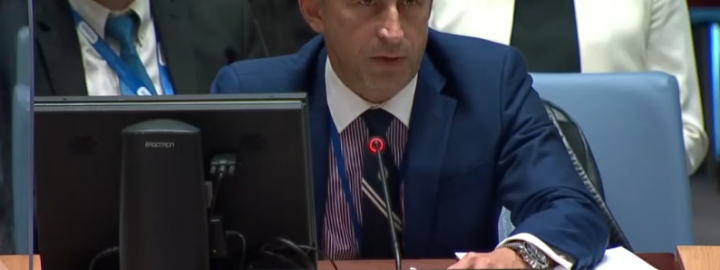
80th Session of the United Nations General Assembly
Agenda Item 75 “The Report of the International Criminal Court”
Statement delivered by H.E. Rein Tammsaar, Permanent Representative of Estonia on behalf of Latvia, Lithuania and Estonia
New York, 11 November 2025
President,
Distinguished delegates,
I have the honour to speak on behalf of the three Baltic States – Latvia, Lithuania and my own country Estonia.
The Baltic States welcome the report of the International Criminal Court (ICC) on its activities and reaffirm our unwavering support to the Court. The ICC plays a vital role in the global fight against impunity for the most serious crimes of international concern. The ICC embodies the collective determination of States to ensure accountability where grave international crimes are committed and to providing justice for victims.
The past year has been challenging to the ICC. In addition to growing workload and increased public attention, the ICC had to face threats and sanctions targeting its judges and officials. The Baltic States stand in full solidarity with the ICC in its mission to uphold justice, accountability, and the rule of law worldwide. We deplore the use of coercive measures and sanctions against the ICC judges and officials. We urge all States to refrain from any action contrary to the Rome Statute. As an independent and impartial judicial body, the ICC must remain shielded from political pressure. All ICC States Parties should stand united in supporting the ICC against any attempts to obstruct its work.
During the reporting period, the arrest warrants in relation to the situations in Afghanistan, the Philippines, Ukraine, and the State of Palestine were issued, reflecting the ICC’s determination to pursue accountability wherever crimes under its jurisdiction are committed. All States Parties should honour their duty to cooperate with the ICC to implement the arrest warrants as non-compliance prevents the ICC from exercising its functions.
As the report makes clear, thirty-three public arrest warrants remain unimplemented, undermining accountability and prolonging the suffering of victims. The integrity of the Rome Statute system depends on full cooperation with States Parties in securing arrests and surrenders. We also fully concur with the ICC reiterating the importance of respecting the Secretary-General’s guidance on contacts with persons who are the subject of arrest warrants or summonses issued by the ICC.
The Baltic States equally condemn the recent cyber-attacks against the ICC. Such acts are unacceptable and constitute an attack not only on the ICC, but on international justice itself. We commend the ICC for having conducted a comprehensive threat assessment of its information and communications technology security infrastructure, and for developing a new security blueprint.
During the reporting period, the ICC once again demonstrated its indispensable role as an independent and impartial judicial body. The conviction of Alfred Yekatom and Patrice-Edouard Ngaïssona for war crimes and crimes against humanity committed in the Central African Republic sent a powerful message that those responsible for atrocities will be held accountable. The confirmation of reparations in the case of Dominic Ongwen in Uganda and the continuing implementation of reparations in the Lubanga, Katanga, Ntaganda and Al Mahdi cases highlight the Court’s unique ability to deliver justice and redress to victims.
The Baltic States recall the essential role of the Trust Fund for Victims in supporting rehabilitation, recovery, and empowerment of victims of atrocity crimes. Trust Fund for Victims has meanwhile extended assistance programmes to 19 500 direct beneficiaries in 2024. Although, in 2024, the Trust Fund received over 5.7 million euros from 29 States, the highest amount since 2004, the Trust Fund has taken further steps to engage additional donors. We repeat our call upon States Parties and other stakeholders to make voluntary contributions to the Trust Fund.
The ICC currently has limited jurisdiction over the crime of aggression. We believe that the ICC should have jurisdiction over all four core crimes under equal conditions. It is regrettable that during the Special Session this July, States Parties were unable to fully address this legal gap. We therefore urge States Parties to intensify their efforts to build consensus towards harmonising the Court’s jurisdiction.
Russia’s unjustified and illegal brutal war of aggression against Ukraine is in its fourth year. By ratifying the Rome Statute, Ukraine made a crucial step towards bringing the perpetrators of war crimes and crimes against humanity to justice. At the same time, we regret that some states have announced their withdrawal from the Rome Statute. We encourage these states to review their decision and remain States Parties to the Rome Statute.
The main culprits of the war of aggression against Ukraine, including the Russian leadership, must be held accountable. The Baltic States welcome the establishment of the Special Tribunal for the Crime of Aggression in the framework of the Council of Europe and call upon all supporting States to join the Enlarged Partial Agreement on the Management Committee of the Special Tribunal to make the tribunal operational as soon as possible. The international community should continue our steadfast support to Ukraine in the fight against impunity.
Thank you!